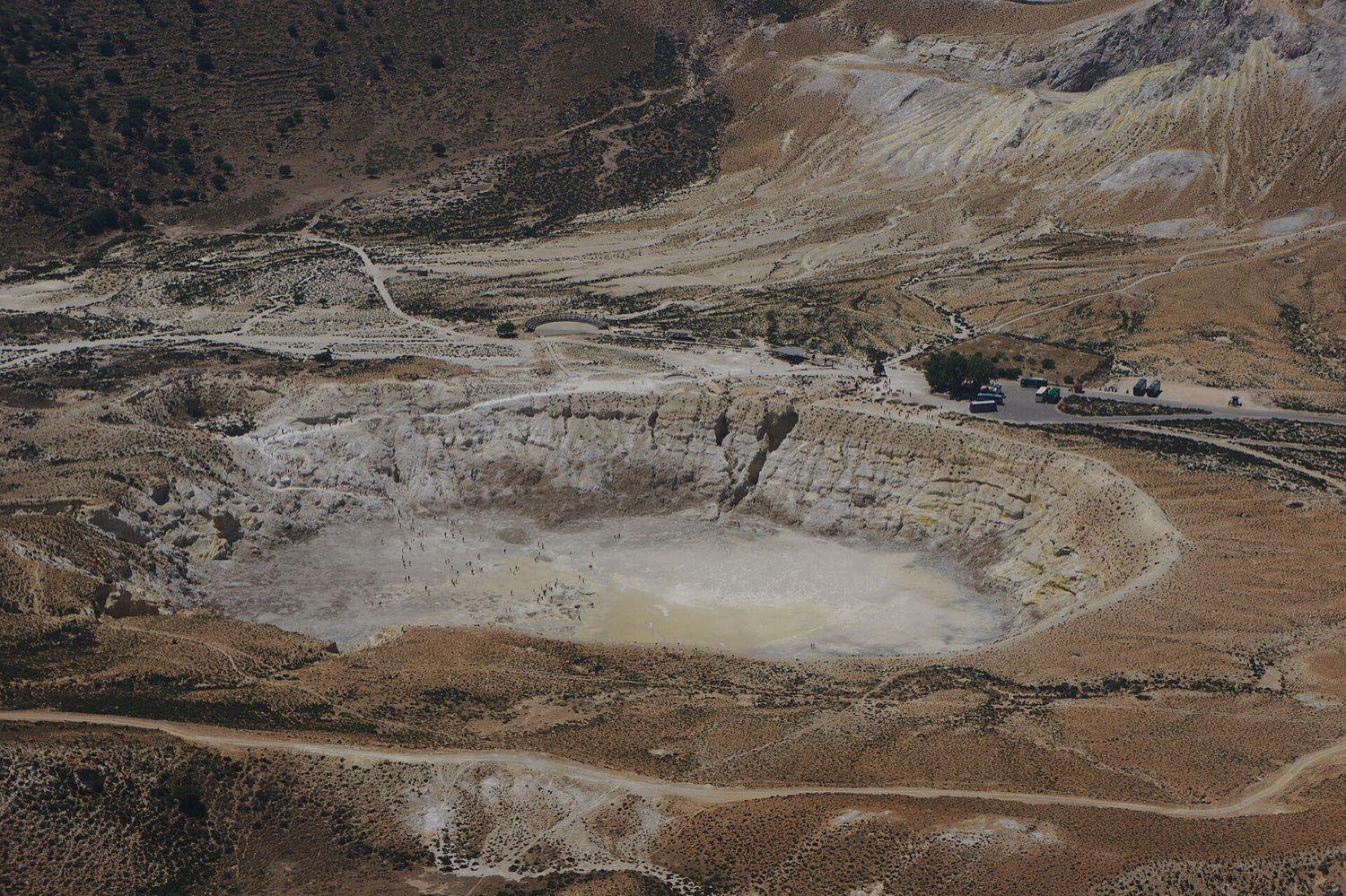
Bare rock and sparse vegetation beside the Stefanos crater on the Nisyros volcano near Kos
Nisyros · South Aegean volcanic arc

The Kos Volcano Day Trip: Nisyros & the Stefanos Crater

The Kos volcano is not on Kos. It is Nisyros, a small island an hour or so south — and the only place in Greece where an ordinary day trip ends with you standing on the floor of an active crater. Hot ground, hissing vents, sulphur you smell for hours.

Stefanos
Crater you walk into
~330 m
Crater width
9–10 h
Typical day trip
May–Oct
Excursion season

Bookable now

Nisyros volcano trips and other Kos excursions with live availability

What you're seeing: real departures for the coming weeks, pulled from GetYourGuide. Volcano trips sail on set days, so open a listing and read the inclusions — that is where the crater fee and the coach transfer are declared.

Powered by GetYourGuide

Quick summary

The Nisyros volcano day trip at a glance

The row that catches most travellers out is the crater entrance fee: it is collected on Nisyros and is not always part of your ticket.

Compiled from operator listings on GetYourGuide for the current season; confirm before booking.
Price from Usually €45–75 per adult for the boat and the coach up to the caldera. Lunch is normally extra.
Departure times Morning sailings, most commonly boarding between 08:00 and 09:30. Your voucher gives the exact time and quay.
Departure ports Kardamena is the closest port to Nisyros and the most common start. Some trips leave Kos Town harbour instead.
Crossing time Roughly an hour from Kardamena and noticeably longer from Kos Town. The operator states it on the listing.
Time to allow 9–10 hours door to door, of which only about 4–5 hours is actually on Nisyros.
Advance booking needed? Yes in July and August. Volcano boats run on fixed days, so a sell-out means waiting for the next sailing, not the next morning.
Crater entrance fee Charged separately at the caldera and often not included. Bring cash and check the current fee locally before you go.
Walking involved A short, steep, loose descent onto the crater floor, then flat walking on hot gravel. Closed shoes only.
What else you see Mandraki, the island's harbour town, and the Panagia Spiliani monastery on the rock above it.

Price bands come from publicly listed operator prices on GetYourGuide for the current season. The crater fee is set on Nisyros, not by the boat operator — confirm it on arrival. How we source numbers.

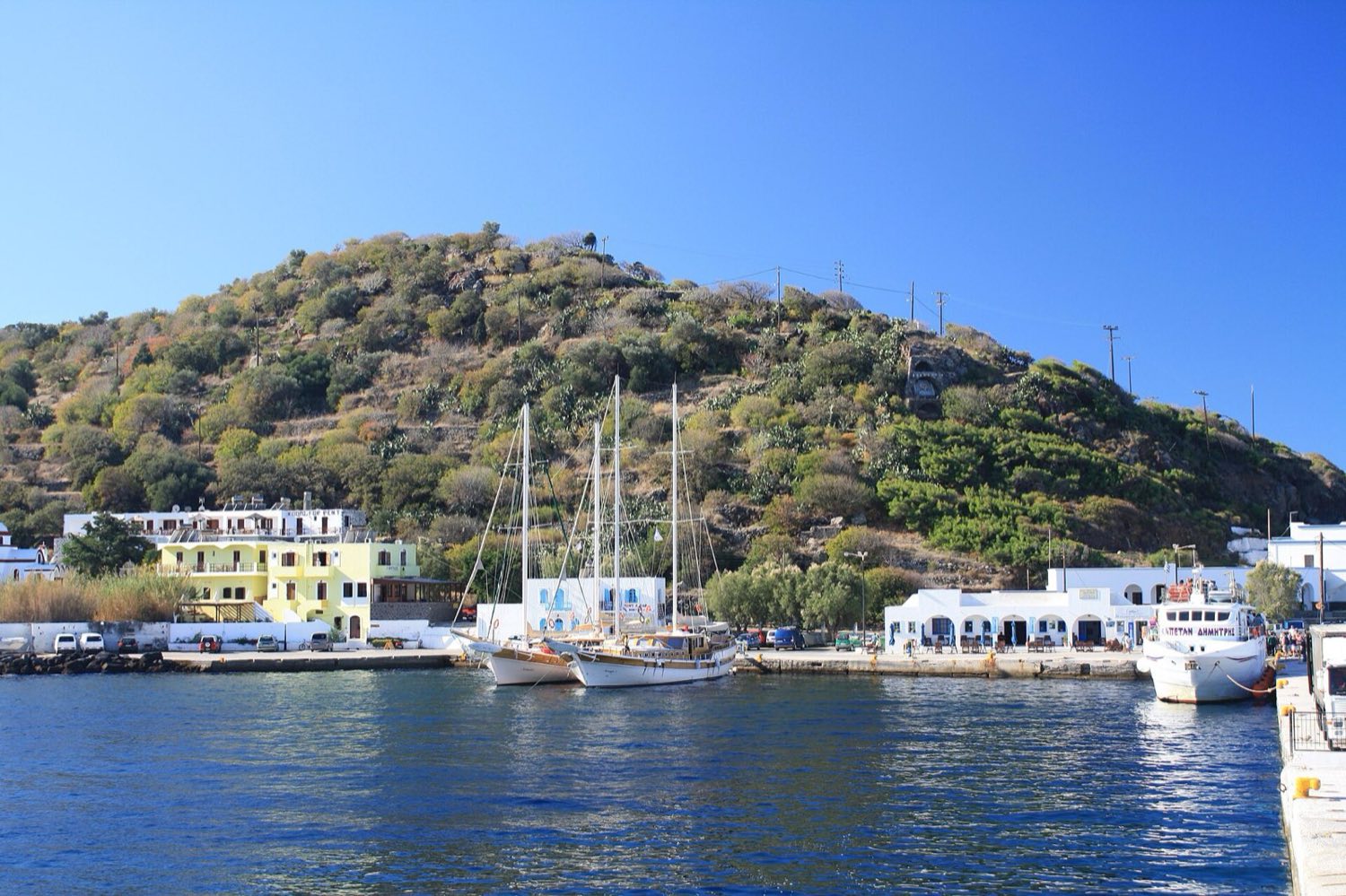
The harbour of Mandraki on Nisyros, where day-trip boats from Kos tie up below the town
Mandraki harbour on Nisyros — boats from Kos tie up here, and the coaches for the caldera wait on the quay.

Do not wear flip-flops

The crater floor is loose grey grit over warm ground, studded with sharp crusted mineral edges. Sandals mean you either turn back at the bottom of the path or spend twenty minutes wincing. Closed trainers, every time.

Three ways to do it

Organised cruise, scheduled ferry or private boat

Three genuinely different ways to reach the Kos volcano, trading money against control of your day. Most visitors should take the organised cruise — but not everyone.

Best balance

Option 1

Organised volcano day cruise

€45–75 / adult, full day


  • Boat from Kardamena or Kos Town
  • Coach from Mandraki quay up to the caldera
  • Roughly 45–60 minutes at the craters
  • Free time afterwards in Mandraki
  • Crater fee and lunch usually extra

Pick this if you want the volcano without solving the transport puzzle yourself. The coach up from the port is the part that is genuinely hard to replace.

Option 2

Independent, by scheduled ferry

Ferry fare + local bus or taxi


  • Small local ferries link Kos with Mandraki
  • You choose how long you stay ashore
  • Can be combined with an overnight on Nisyros
  • Sailings are limited and seasonal
  • You arrange your own ride to the crater

Pick this if you want a slow day, an overnight, or the caldera rim villages. Check the current schedule first — see the Kos ferry guide.

Option 3

Private boat charter

Per boat not per person


  • Your own departure time and swim stops
  • Sensible with small children or mobility needs
  • Swim on the way, which cruise boats rarely do
  • Expensive unless you are six or more
  • Still need transport up from Mandraki

Pick this if you are a group and the fixed 09:00 boarding and shared coach are the parts you object to. See how charter pricing works.

Read the inclusions, not the headline

Two boats can list within €10 of each other and deliver very different days. The variables are the coach up to the caldera, the crater fee, lunch, and how long you get at the rim. A cheaper ticket that drops you in Mandraki with no onward transport is a different trip.

Rock and low vegetation on the rim above the Stefanos crater, Nisyros volcano
The rim above Stefanos. The path down leaves from a corner of the car park and the last few metres are loose.

On the ground

What walking into the Stefanos crater is actually like

The descent

Coaches stop at a car park on the rim, and a single rough path drops from one corner of it onto the crater floor. A few minutes, but steep and covered in loose grit — come down sideways and take a hand off your phone.

The floor

Stefanos is a flat grey pan roughly 330 metres across, walled by crumbling cliffs. Walk on the pale, obviously trodden ground. The yellow and white crusted patches are the vents: hotter than they look, the crust can give way, and the steam is not merely warm.

The smell, and the noise

Hydrogen sulphide gives the caldera its rotten-egg smell. It fades from your attention within ten minutes and returns when the wind shifts. The fumaroles genuinely hiss — stand still on the far side of the pan and you can hear the volcano working.

Managing the heat

The crater is an unshaded bowl with reflective walls, so it runs several degrees hotter than the coast. Bring more water than you think you need. With a respiratory condition, or if you are pregnant, view the vents from the rim instead.

Insider: which end of the pan

Most groups cluster at the bottom of the path and photograph each other. The active ground sits on the far side of the crater, a five-minute flat walk away. Go there first, then come back — you get the vents and clean photographs.

Timing

When to sail to the volcano, and when not to

Two forces shape this trip: the heat inside the crater, the north wind outside it.

Best months

  • Late May to mid-June — the best combination here: bearable crater, calmer sea, boats not full.
  • July–August — the crater floor at midday is punishing and the meltemi is at its strongest. Do it, but prepared.
  • September to early October — cooler ground, warm sea, thinning crowds. Sailings reduce through October.
  • November to April — no excursion boats, only scheduled ferries on a thin winter timetable.

The meltemi factor

The crossing runs south into open water, and the meltemi — the northerly summer wind that builds through the afternoon and peaks in July and August — is the usual reason a volcano trip is cancelled. Operators decide the evening before or at dawn.

So book this trip early in your holiday. Volcano boats do not sail daily, and a cancellation on your last full day cannot be rebooked into anything.

Best hours ashore

You cannot choose your arrival time on an organised trip, but you can choose the order of your afternoon. Reach the rim before midday and do the crater first, Mandraki after. Arrive in the early afternoon heat and go straight to the far vents, then back up.

Quietest days

The caldera fills and empties in waves, because everyone arrives by coach off the same few boats. Tuesday and Wednesday sailings tend to be quieter than weekend ones, which carry the week's fresh arrivals.

Best light for photographs

Flat overhead light kills a grey crater. The strong frames come when the cliff walls throw shadow across the pan — before about 11:00 or after 16:00. Mandraki's whitewashed lanes photograph best late, on the way back to the boat.

Practical access

Mandraki and Panagia Spiliani: how to fit them in

Mandraki is Nisyros's harbour town and capital: white cube houses, lanes narrow enough to touch both walls, and a rock behind the town carrying a Knights-era castle. Panagia Spiliani, the cave monastery of the Virgin of the Cave, sits inside those walls — the same order of knights that built Neratzia Castle on Kos.

The route is unmarked in the way small Greek towns always are: from the quay, follow the seafront into the main lane, keep going until it starts to climb, then take the stepped alley on your right that switchbacks up the rock. Five to ten minutes, mostly shaded, with the best harbour view from the terrace at the top.

Dress for a working monastery — shoulders and knees covered — and expect a queue: the chapel inside the rock holds very few people at once.

The mistake almost everyone makes

Your time ashore is 4–5 hours and the crater eats half of it. That leaves one unhurried thing, not three. Choose in advance: the monastery climb or a long lunch on the waterfront. Attempting both is how people end up jogging back to the quay.

If you have spare time in Mandraki

  • Local specialities — soumada, an almond cordial, and the island's dried figs. Both travel well and cost less than anything in the Kos Town tourist lanes.
  • The rim villages, Emporios and Nikia, look straight down into the caldera — realistic only with your own transport or an overnight.

Accessibility, honestly

The crater floor is not wheelchair accessible and the path down is unsuitable for anyone unsteady on loose ground. The rim viewpoint at the car park is a real alternative — the whole pan and its vents, seen from above.

How to save

Cutting the cost of the Kos volcano trip

Child and family rates

Operators price children below full fare and infants often travel free, but the age cut-offs are set per boat — read the booking page rather than assuming. The crater fee has its own reductions, set on Nisyros.

Buy lunch, don't book it

Ticket versions with lunch included cost noticeably more, and lunch here means a taverna in Mandraki, not anything unusual. Skip the catered option and eat at the far end of the waterfront where the crews do.

Leave from Kardamena if you can

Kardamena is the closest Kos port to Nisyros, so sailings from there spend less of your day at sea and often cost less. Free money if you are on the south coast.

There is no island pass

Kos has no island-wide sightseeing pass, and nothing sold on Kos covers the crater fee. Ignore anything marketed as an official all-island ticket. Real savings come from operator bundles and shoulder-season pricing, which can run 20–30% below August.

Free alternatives on Kos itself

If the volcano is out of budget, Kos has its own geothermal water for nothing: the free thermal pool at Embros Therma is fed by the same regional volcanism.

What a Nisyros day realistically costs per adult
ItemBudget
Boat plus coach to the caldera€45–75
Crater entrance feePaid locally, cash
Lunch in Mandraki€12–25
Water and a cold drink€4–6
Bus or taxi to your port on Kos€2–30

Ranges compiled from publicly listed operator prices on GetYourGuide and typical taverna pricing in the Dodecanese for the current season. The crater fee is set locally and we do not publish a figure for it — confirm on arrival.

Bring cash

Card acceptance is patchy once you leave the Mandraki waterfront, and the crater fee is collected in person. Take euro notes and coins from Kos with you.

How to get there

Getting from your hotel to the volcano boat

Most of the logistics happen on Kos, before you sail. The wrong port is the one mistake you cannot fix.

  1. Read your voucher the night before

    It names the port — Kardamena or Kos Town, 30 km apart — plus the quay and boarding time. Screenshot it in case you have no signal in the morning.

  2. If you sail from Kardamena

    Kardamena is on the south coast, roughly 30 km from Kos Town — allow 40 minutes by road, more in the morning airport rush. KTEL buses serve it; taxis are metered. An optional hotel pickup usually beats a return taxi from outside town.

  3. If you sail from Kos Town harbour

    Boats board along the quay below Neratzia Castle, walkable from anywhere in the town centre. Free parking nearby is gone by 08:30 in summer — use a paid lot, or cycle in on the flat separated bike lanes.

  4. Board 20–25 minutes early

    Volcano boats use open seating. The shaded upper-deck benches go within ten minutes of boarding, and on a southbound crossing in July you will want one.

  5. On Nisyros: the quay to the caldera

    Coaches wait on the Mandraki quay and climb the ridge to the rim car park — a short, winding road with a real drop on one side. Prone to travel sickness? Sit at the front.

Context

Why there is a live volcano off the coast of Kos

Nisyros is one link in the South Aegean volcanic arc, the curve of volcanic centres running from the Saronic Gulf through Milos and Santorini to the Turkish coast. The arc exists because the African plate is being forced beneath the Aegean. Kos sits on the same geology — hence its thermal springs.

The northern half of Nisyros is a caldera: a collapse basin several kilometres across, formed when the roof of an emptied magma chamber dropped. Hence the island's odd shape from the boat — a ring of steep hills around a hidden flat plain, the Lakki, where the craters are. Stefanos is the largest and youngest, and it is a hydrothermal crater, blasted out by superheated groundwater flashing to steam.

That distinction decides what you see. There is no lava on Nisyros. What there is, is a live hydrothermal system: groundwater meeting hot rock a few hundred metres down and venting sulphurous steam through the crater floor. The last violent episodes were hydrothermal explosions in the late nineteenth century, and the island has been monitored ever since.

The Greeks explained it with a fight. In the war between gods and giants, Poseidon is said to have torn a lump off Kos and thrown it onto the giant Polybotes to pin him down; the island is the lump and the rumbling is the giant. One of the craters still carries the name Polyvotis.

People still live here — a few hundred, between Mandraki, the rim villages of Emporios and Nikia, and the small port of Pali. For how a volcano day compares with the other off-island trips, see the excursions overview, or the 3-island cruise guide for the northern neighbours most visitors choose instead. The Kos boat trips home page has the wider picture.

FAQ

Kos volcano trip: common questions

Is there a volcano on Kos itself?

No. What people mean by the Kos volcano is Nisyros, a separate island to the south that is reached by boat as a day trip. Kos sits on the same volcanic geology, which is why it has thermal springs at Embros Therma, but there is no crater on Kos.

Is the Nisyros volcano still active?

Yes, Nisyros is classed as an active volcano and is monitored. Its activity today is hydrothermal rather than magmatic: groundwater heated by rock below the caldera vents sulphurous steam through the crater floors. There is no lava, and the last violent episodes were hydrothermal explosions in the late nineteenth century.

Can you walk inside the Stefanos crater?

Yes. A short, steep path drops from a corner of the rim car park onto the crater floor, which is a flat grey pan roughly 330 metres across. Stay on the pale trodden ground and keep away from the yellow crusted vents, where the crust is thin and the steam is hot enough to scald.

Is the crater entrance fee included in the day trip?

Often not. The fee is collected at the caldera on Nisyros and is separate from your boat ticket unless the listing says otherwise. Read the inclusions before you book and carry euros in cash, because card payment on the rim is not something to rely on.

What shoes should I wear on the Nisyros volcano?

Closed shoes with a sole you trust, ideally trainers or light walking shoes. The descent is loose grit, the crater floor is sharp underfoot and the ground is warm enough to be felt through thin soles. Flip-flops and open sandals are the single most common mistake on this trip.

How long does the Nisyros day trip from Kos take?

Allow 9 to 10 hours door to door. Boarding is normally in the morning, the crossing takes about an hour from Kardamena and longer from Kos Town, and you get roughly 4 to 5 hours on Nisyros in total. The crater visit itself accounts for about half of your time ashore.

Is the volcano trip suitable for children?

It works well from roughly age six upward, provided they are in proper shoes and will hold a hand near the vents. It is a long day for toddlers, and the crater is hot, exposed and smells of sulphur. With very young children, consider the rim viewpoint only, or a shorter boat day instead.

Can I visit Nisyros without booking a tour?

Yes. Small scheduled ferries connect Kos with Mandraki, so you can travel independently and even stay overnight. The catch is that sailings are limited and seasonal, and you have to arrange your own transport from the port up to the craters. Check the current schedule before committing to a date.

Ready to stand in a crater?

Check live departures, prices and cancellation terms for the Nisyros volcano day trip from Kos on GetYourGuide — the authorised reseller we link to throughout this guide.